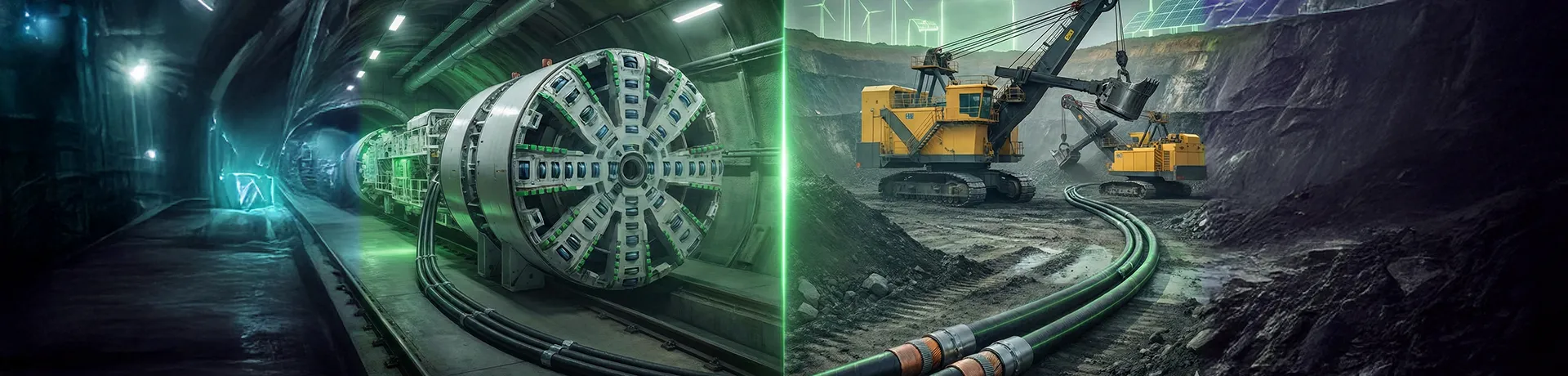
Reeling and trailing cables produced to AS/NZS 2802 are likewise powerful adaptable cables, however are fundamentally intended for other than underground coal mine aplications. These involve two classifications of link – Class 1, which (To upgrade general dealing with attributes) are structured with more slender protection and sheath when contrasted and identical size and voltage of Class 2 cables.
The reeling and trailing cables to the two Australian measures (2802 and 2802) are equivalent to, and much of the time outperform the most stringent known universal models.
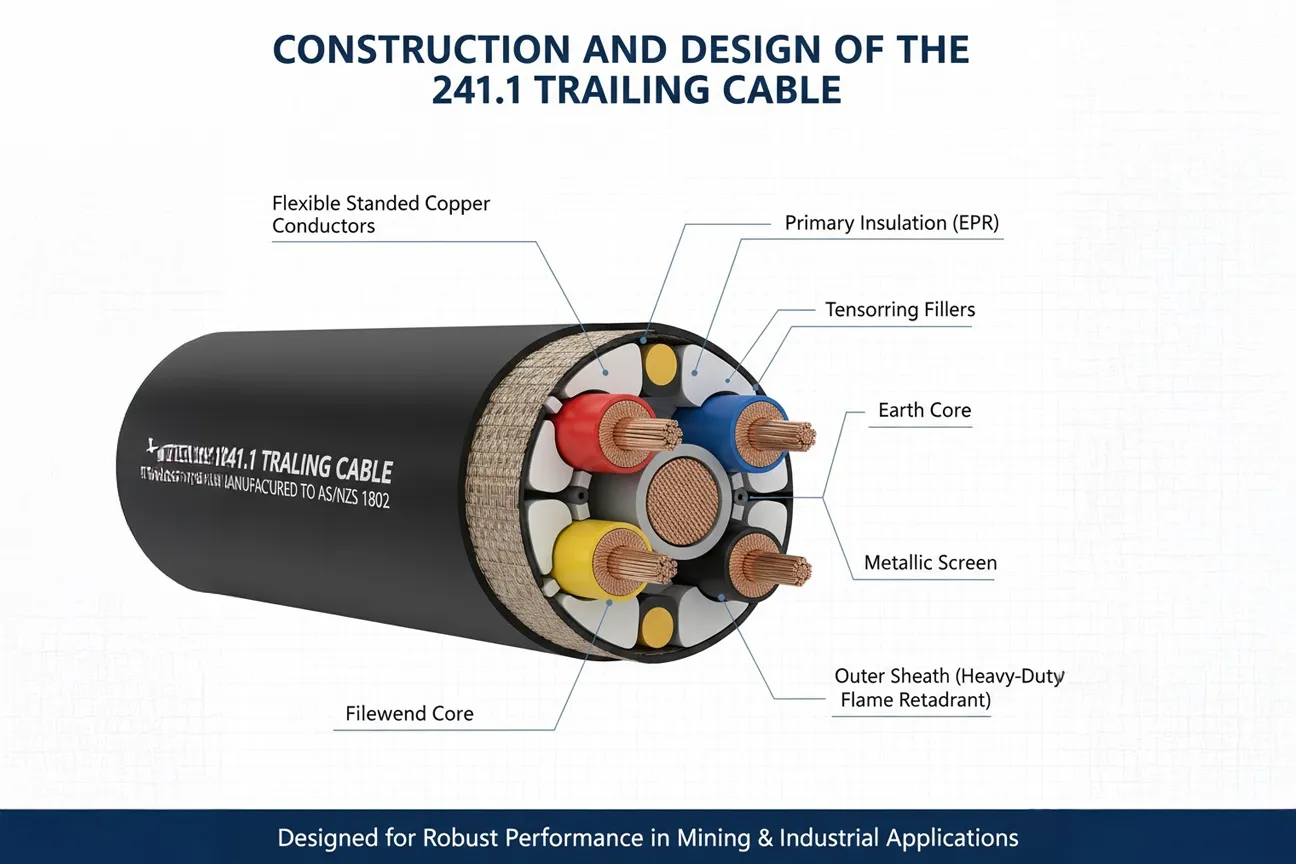
The construction of a type 241.1 trailing cable involves several components and layers designed to provide durability, flexibility, and electrical performance. While the specific construction may vary between manufacturers, here is a general overview of the typical components found in a type 241.1 cable:
Conductors : The conductors are the core of the cable and carry the electrical current. Type 241.1 trailing cables usually consist of multiple stranded copper conductors, which offer flexibility and conductivity. The number and size of the conductors depend on the specific application and current-carrying capacity requirements.
Insulation : Each conductor is individually insulated to prevent electrical leakage and ensure insulation integrity. Common insulation materials used in Type 241.1 cables include PVC (polyvinyl chloride) or XLPE (cross-linked polyethylene). These materials provide electrical insulation and resistance to environmental factors such as moisture, chemicals, and abrasion.
Filler : A filler material, such as a textile or synthetic material, is often used to maintain the circular shape of the cable and provide additional mechanical strength.
Shielding : Type 241.1 trailing cables may have shielding layers to protect against electromagnetic interference (EMI) and minimize signal interference. The shielding can be achieved through braided copper wires or aluminum foil wrapped around the insulated conductors.
Sheath : The outermost layer of the cable is the sheath, which provides mechanical protection and insulation for the internal components. The sheath is typically made of PVC or other robust materials resistant to abrasion, impact, oil, and sunlight exposure.
Reinforcement : In some cases, Type 241.1 trailing cables may include reinforcement layers, such as textile or steel wire braids, to enhance the cable’s tensile strength and resistance to external mechanical stress.
Type 241.1 cable is a type of cable that is extensively used in a variety of applications. It is also known as a control cable or an instrumentation cable. Here are some examples of typical applications for type 241.1 cable:
Type 241.1 cables are extensively used in industrial automation systems to send control signals and communicate between various components such as programmable logic controllers (PLCs), sensors, actuators, and other equipment. In tough industrial situations, they provide dependable signal transmission, flexibility, and resistance to electromagnetic interference (EMI).
Type 241.1 cables are appropriate for process control applications in industries such as oil and gas, chemical processing, and manufacturing. They connect and control instruments, transmitters, and measurement devices, ensuring precise data transfer for monitoring and controlling factors including pressure, temperature, flow, and level.
Power producing facilities, such as thermal power plants, hydroelectric plants, and renewable energy projects, use Type 241.1 cables. They connect equipment like generators, transformers, switchgear, and control panels for control and communication.
Type 241.1 cables are used in building automation systems to control and communicate between various components such as HVAC (heating, ventilation and air conditioning) systems, lighting controls, security systems and access control systems. They enable dependable signal and data transmission for efficient building control and energy optimisation.
Type 241.1 cables are used in transportation systems and infrastructure construction projects. They are used in railways, airports, subways, and tunnels for control and signaling reasons, assuring smooth operation, safety, and communication between various subsystems and devices.
Control and instrumentation cables of type 241.1 are acceptable for use in water and wastewater treatment plants. They provide signal and data communication between various monitoring and control devices, including pumps, valves, level sensors, and analyzers, in order to maintain optimal process efficiency and regulatory complia
For the best performance and efficiency, type 241.1 mining cables are the best for every mining industry and activity. We at Znergy Cable are the best electrical cable manufacturer in Australia with a wide range of Australian solar cables, fire-rated cables and mining cables.
Znergy is an Australian-based cable engineering and manufacturing group supplying power cable solutions to mining, infrastructure, and industrial markets
© 2026 All Rights Reserved by Znergy Cable | Designed By FODUU